Connect with permission
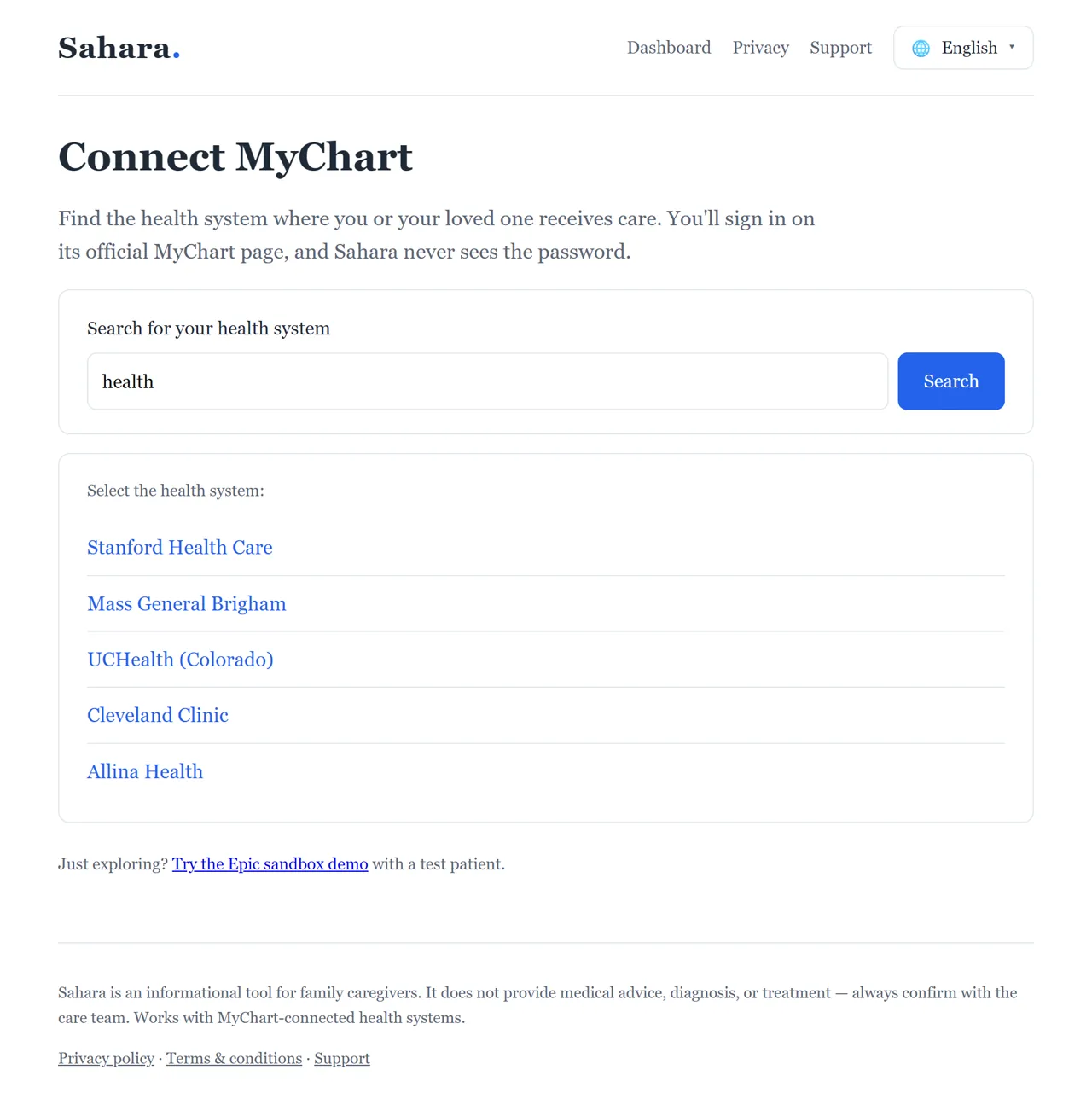
Choose a participating organization and use its authorized MyChart sign-in flow. Availability varies by organization.
US healthcare › Patient-facing app
Live and free todayसहारा
Authorized record data, trusted general education, and optional language support in one read-only view.
Sahara connects through a supported MyChart flow, keeps patient-specific data distinct from general education, and leaves medical decisions with patients and their care teams.
You sign in on your healthcare organization's page. Sahara never asks for your MyChart password.

Direct answer
Sahara retrieves authorized health record information in a read-only view, attaches trusted general education to supported coded items, and offers optional language support. It does not interpret results or make clinical decisions.
Product tour
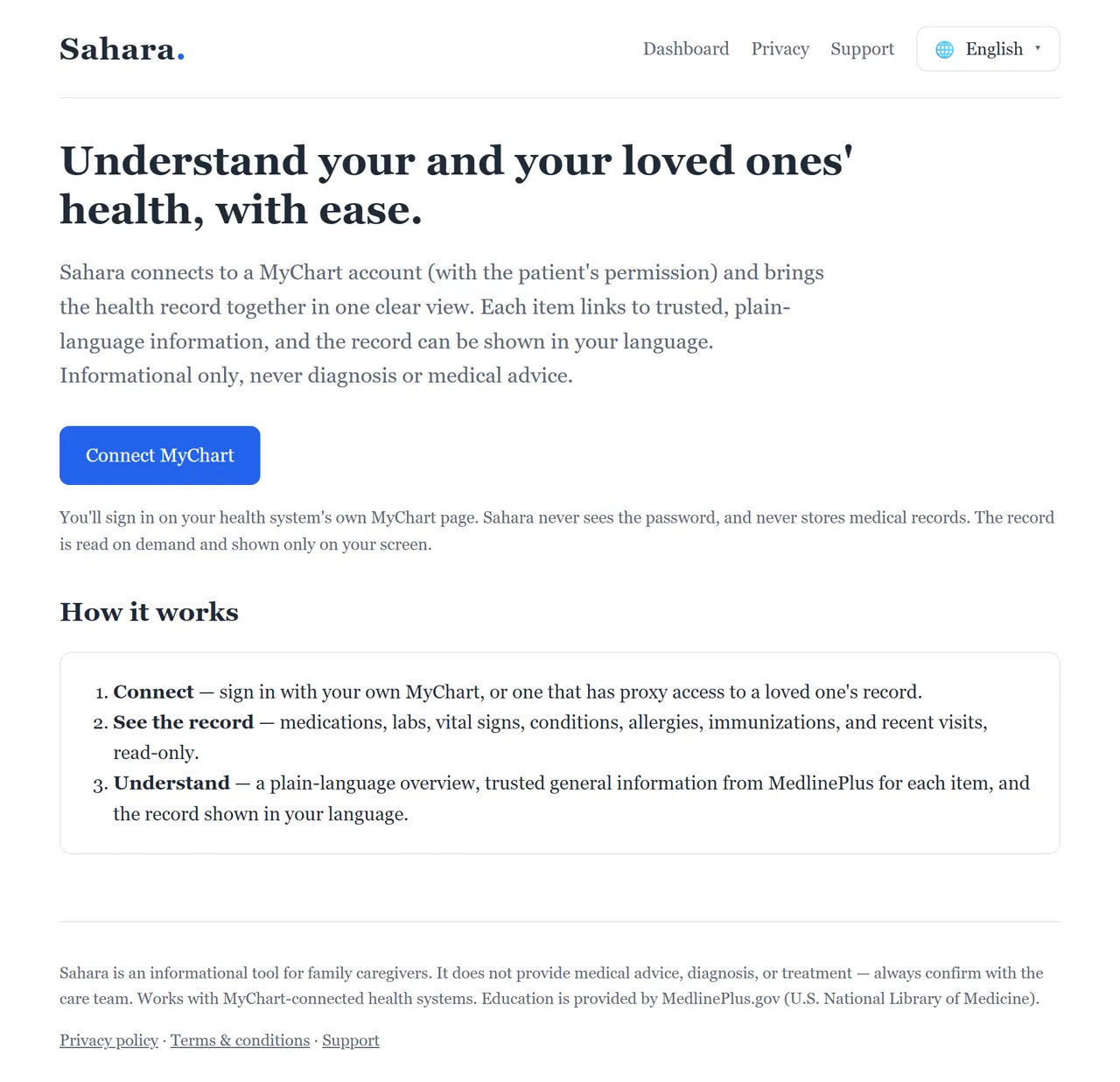
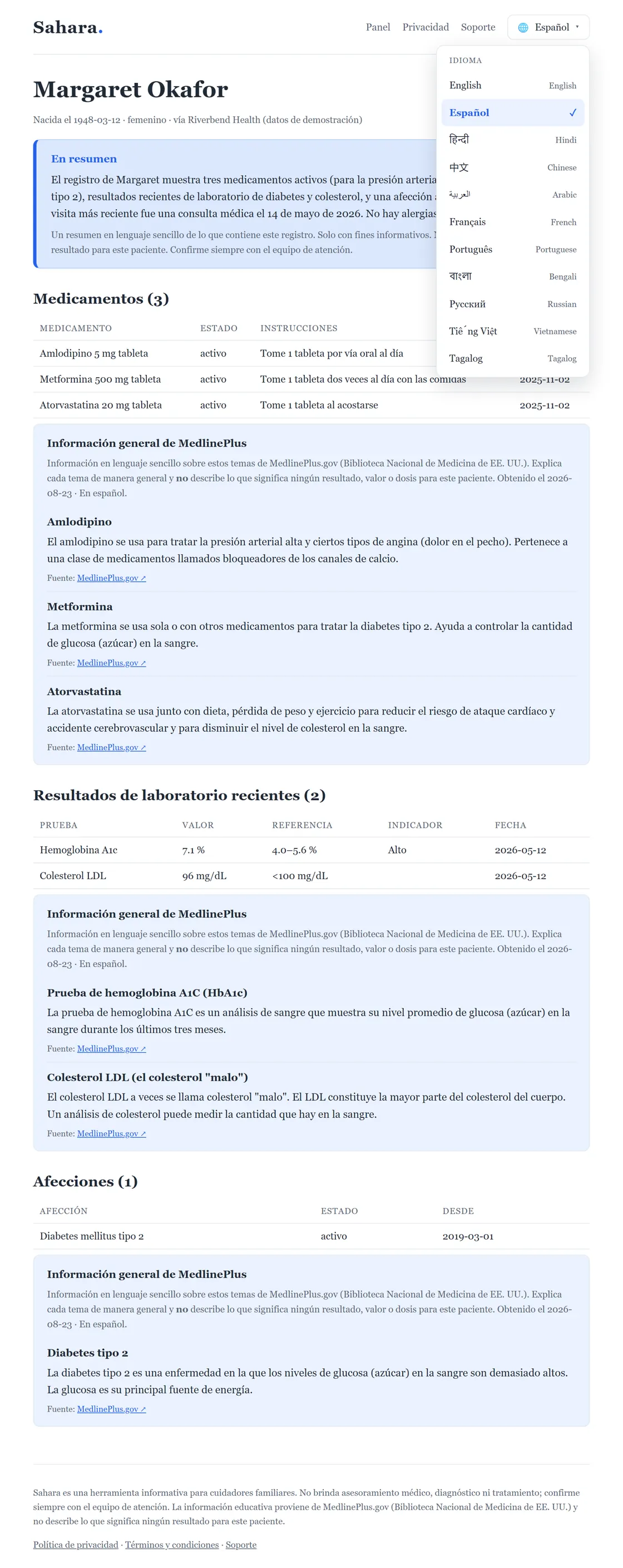
These are current Sahara screens. No real patient data is shown.
You can also open the working app instead of looking at pictures of it. The demo record needs no sign-in and no health system, and it runs a synthetic record through the same views a connected record uses. Open the demo record.
How it works
Choose a participating organization and use its authorized MyChart sign-in flow. Availability varies by organization.
See supported medications, allergies, labs, vitals, conditions, immunizations, and recent visits in a read-only view.
For supported coded items, open clearly separated MedlinePlus information and optional language support without turning it into patient-specific advice.
Sahara questions
Sahara is a free, patient-facing web app from Synodha. It presents authorized health record information in a clearer read-only view, links supported coded items to general patient education from MedlinePlus, and offers optional language support. Sahara does not diagnose, prescribe, interpret a result for a patient, or change the source record.
Yes, where a participating healthcare organization makes the required connection available. You choose the organization, sign in through its authorized MyChart flow, and permit Sahara to retrieve supported record data. Availability and the data returned vary by organization. Sahara is not endorsed by Epic or by any participating health system.
Only when you have authorized access. Some healthcare organizations support proxy or caregiver access through MyChart, but the rules and available data vary. Use the health system's own authorization process and never use another person's credentials without permission. Sahara does not create or expand proxy access.
Sahara is designed not to retain the medical record after the session. It retrieves authorized data to generate the current view and uses data minimization before optional translation processing. Review the live Privacy Policy for the current handling, processors, retention terms, deletion options, and the limited account or usage data that may be retained.
Depending on what the connected organization provides, Sahara can show medications, allergies, laboratory results, vital signs, conditions, immunizations, and recent visits. It is a read-only view. Missing information does not mean the information does not exist, and the source health system remains the authoritative record.
For supported coded items, Sahara can show a title, short general explanation, and source link from MedlinePlus, a service of the U.S. National Library of Medicine. This information describes the topic generally. It does not explain what a medication, condition, or test result means for a particular patient.
No. Sahara does not provide medical advice, diagnose a condition, recommend treatment, check interactions, or interpret a result for a particular patient. Keep the source record visible and contact a qualified clinician or pharmacist for patient-specific questions. For an emergency, use local emergency services.
Sahara is free today and does not currently collect in-app payments. MedlinePlus education is shown in English or Spanish when available. Optional translation can present supported record content in additional languages. Coverage varies by record item and language, so keep the original source visible and confirm anything unclear with the care team.
Authoritative general education: MedlinePlus Connect from the U.S. National Library of Medicine. Medication safety context: FDA guidance on using medicines safely. These sources do not endorse Sahara. Reaching a loved one's record starts with what your health system requires for proxy access.
Sahara is for general educational use. It does not provide medical advice, diagnose, prescribe, interpret patient-specific results, check interactions, or replace a clinician, pharmacist, emergency service, or the source health record. Connection availability and returned data vary by healthcare organization.