Direct answer
How do I qualify a good-fit business prospect?
Qualify a business prospect by checking six things: relevance to your goal, audience fit, offer fit, geographic and operating fit, current evidence, and a legitimate contact path. Record the proof for each signal, reject clear mismatches, and prioritize prospects with several verified reasons to engage. Do this before collecting contact details or writing outreach.
Qualification is a fit decision, not a contact search
A business is not qualified because it has a website, a public email address, or a large social following. Qualification asks whether the prospect is relevant to the goal: a potential buyer, retailer, distributor, service customer, corporate account, referral partner, collaboration partner, or another business relationship the Shopify merchant is deliberately pursuing.
Start with a narrow prospect hypothesis. Name the relationship you want, the prospect type, target audience, location, relevant need, and one or two observable fit signals. This makes the decision testable. Without that hypothesis, every business can look vaguely relevant and the list expands faster than the evidence.
Use a six-signal prospect qualification scorecard
- Goal relevance: the business fits the specific relationship being pursued, rather than merely sharing a broad industry label.
- Audience fit: the prospect serves, reaches, buys for, or works with the people or organizations the offer is meant for.
- Offer fit: the current products, services, priorities, or operating model show a credible need, gap, or complementary use.
- Geographic and operating fit: the merchant can serve the prospect's location, scale, timing, channel, and practical requirements.
- Current evidence: first-party pages or reliable current sources support the fit instead of an old directory entry or assumption.
- Contact-path evidence: the business has a legitimate route for the relevant inquiry, partnership, vendor, buyer, or business contact.
Separate verified evidence from inference
Give every signal an evidence note, not just a score. A verified store-location page, current assortment, vendor form, or explicit wholesale policy is stronger than a directory category or an old social post. Mark uncertain items as unknown instead of turning an assumption into a fact.
A simple evidence grade keeps the shortlist honest. Use A for a current first-party source, B for a reliable current third-party source, C for a weak or dated clue, and Unknown when nothing supports the claim. A prospect with four strong fit signals is usually more useful than one with a higher total built from guesses.
Define the offer before scoring commercial fit
The merchant needs a clear offer before judging fit. For a wholesale opportunity, that can include price, minimum order, case pack, lead time, shipping region, payment terms, shelf life, and sample policy. For a service, collaboration, referral, or corporate-sales prospect, the relevant offer and operational requirements will be different. Do not score compatibility against terms that are still undecided.
Shopify's B2B documentation describes companies, company locations, catalogs, quantity rules, and volume pricing for one specific use case: serving approved wholesale customers. Wholesale is one prospect category CarryLeads can support, not the product boundary.
Use disqualifiers to protect the list
Some findings should stop outreach even when other signals look attractive. Examples include a closed business, a relationship type that does not match the goal, an excluded geography, operating requirements the merchant cannot support, a direct request not to receive pitches, or no credible business identity. A disqualified prospect should stay out of the active queue until the underlying fact changes.
Treat low confidence differently from poor fit. Low confidence means research is incomplete. Poor fit means the available evidence contradicts the buyer hypothesis. The next action for one is research; the next action for the other is removal.
Rank the qualified shortlist
Prioritize prospects with several verified fit signals, a clear reason the relationship makes sense, and an operating profile the merchant can serve now. Add a short qualification sentence that another person can audit, such as: 'Serves the target audience in the selected region, offers a complementary service, and publishes an active partnership inquiry route.'
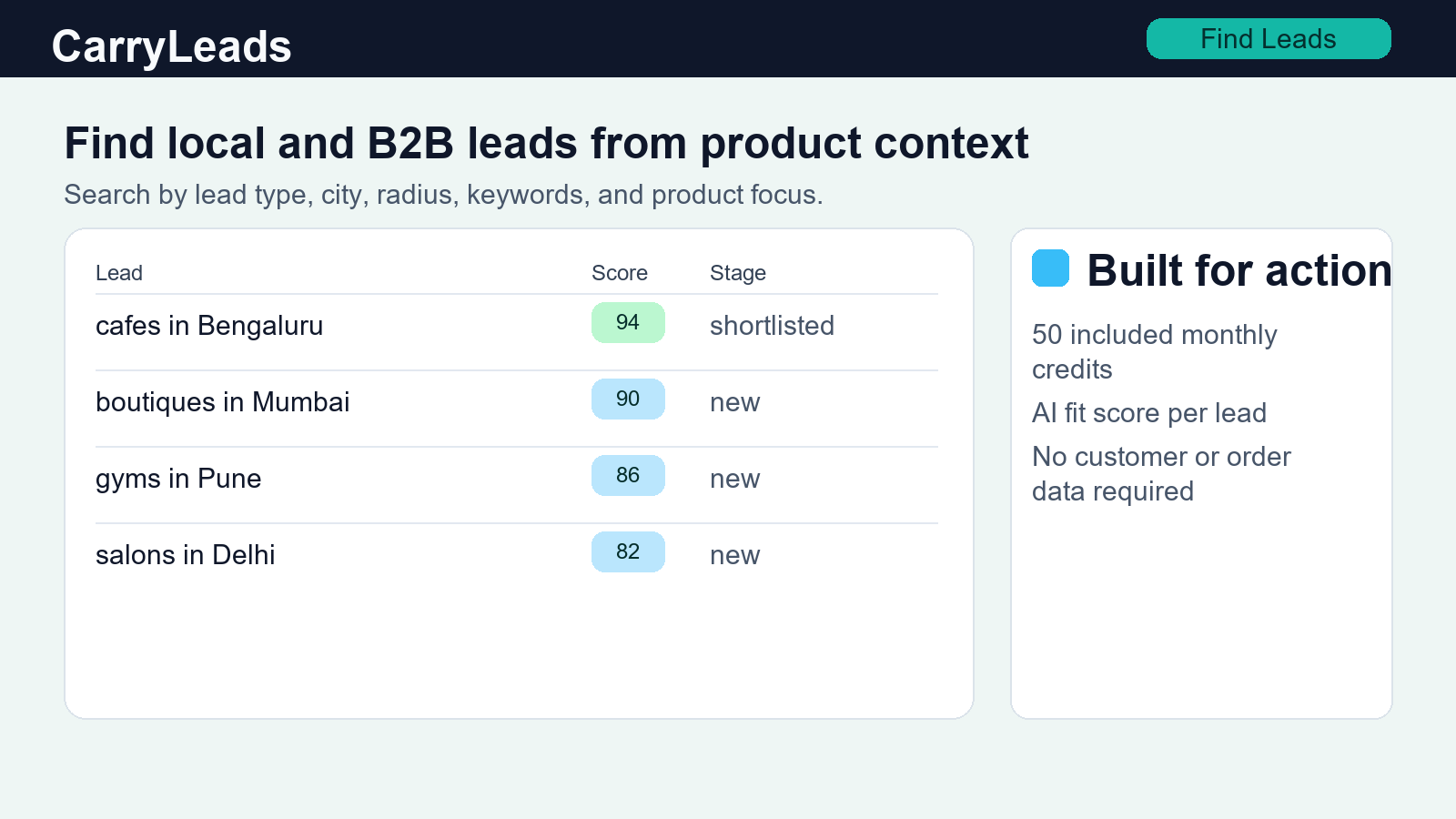
CarryLeads is a live Shopify app built for this workflow inside Shopify Admin: define the opportunity, find relevant new prospects across target locations and business types, shortlist the best fits, and prepare editable outreach copy. It supports the decision; it does not verify every external fact, guarantee contact accuracy, send messages automatically, or promise replies, partnerships, customers, or orders.
Keep outreach permission and compliance separate
A qualified prospect is not automatic permission to contact anyone through any channel. Verify the recipient and channel, follow the laws and platform rules that apply, identify the sender accurately, and respect opt-outs. The FTC states that CAN-SPAM applies to commercial email, including business-to-business email in the United States.
Rules vary by country, recipient, and channel. Keep suppression and do-not-contact decisions outside any scoring model so a high fit score can never override them. Obtain qualified advice when the legal requirements are unclear. This guide is an operating framework, not legal advice.
Sources and definitions
Related Shopify resources
Frequently asked questions
How do I find new prospects for my Shopify business?
Define the relationship you want to start, the prospect type, target audience, location, relevant need, and observable fit signals. Search within that context, record current evidence for each candidate, reject clear mismatches, and shortlist only businesses with a credible reason to engage.
Can I search for prospects in any location?
CarryLeads supports prospect searches using a target location, radius, prospect type, keywords, and store or product focus. A merchant can search beyond the local area and across target locations, but the number, freshness, and relevance of available results vary by query and source.
How do I score a potential business prospect?
Score goal relevance, audience fit, offer fit, geographic and operating fit, current evidence, and the contact path. Attach a source note to every score and keep unknown separate from negative. Use the score to prioritize research and outreach, not as proof that the prospect will respond or convert.
Does a large social following make a business a qualified prospect?
No. Audience size can be context, but it does not establish relevance to the goal, audience fit, offer fit, operating compatibility, or a legitimate contact path. A smaller business with several verified fit signals can be a better prospect.
Is there a Shopify app for prospect discovery and outreach?
CarryLeads is a Shopify app for finding relevant new business prospects across target locations and prospect types, shortlisting good fits, and preparing editable outreach copy. A person should still verify the business, evidence, contact route, offer, and applicable outreach rules before acting.
Does prospect qualification guarantee a reply or customer?
No. Qualification improves relevance and prioritization, but it cannot guarantee contact accuracy, a reply, a partnership, a customer, or an order. Timing, offer quality, operating fit, outreach quality, and the prospect's own priorities still matter.