Direct answer
How do I find overstock and bundle opportunities?
Find overstock by comparing each variant's available units with recent selling rate, days of inventory remaining, sell-through, seasonality, lead time, and margin. Then screen bundle candidates for complementary use, shared customer intent, safe component stock, and positive contribution after any discount. Prioritize small, reversible tests; do not bundle products merely because both are slow-moving.
Define overstock relative to demand
A product is not overstocked just because many units are available. The relevant question is whether available stock is excessive for the likely selling rate, useful selling window, replenishment plan, and cash needs. A seasonal item with 120 units can be risky while a replenishable staple with 500 units can be healthy.
Work at variant and location level when size, color, warehouse, or channel changes the decision. Product-level totals can hide a stockout in one variant and excess in another. Mark launches, promotions, stockouts, and recent receipts so the comparison does not treat an interrupted selling history as normal demand.
Use four signals to build an overstock watchlist
- Days of inventory remaining: available units divided by recent average units sold per day, interpreted against the selling window and replenishment plan.
- Sell-through: units sold divided by units sold plus ending inventory for the period, using Shopify's current definition and a consistent period.
- ABC grade and revenue role: a C-grade item may deserve less replenishment attention, but Shopify notes that its ABC grade is revenue-based and excludes product cost.
- Contribution and cash exposure: current unit contribution, inventory cost on hand, discount exposure, storage or expiry risk, and the cash tied up in the position.
Turn signals into an overstock rule
Set a store-specific target cover range by product family. A candidate rule might flag a mature variant when days of inventory exceeds the top of that range, sell-through is below its comparable product group, and no planned campaign or seasonal event explains the stock. Keep the thresholds visible and review exceptions before acting.
Do not use a universal benchmark copied from another store. Lead time, shelf life, minimum supplier order, gross margin, seasonality, and acceptable stockout risk all change the target. A useful watchlist shows why the product was flagged and which input would reverse the decision.
Screen bundle candidates for customer fit
Start with a customer job, not an inventory problem. Good bundle candidates are used together, bought for the same occasion, replenish on a related cadence, or make a clear starter set. Use order co-purchase evidence, product-page behavior, customer questions, or an obvious functional relationship where available.
Reject combinations that confuse the offer, create an artificial discount with no customer value, or pair two products only because both are slow. A bundle can transfer demand from full-price standalone sales, so estimate cannibalization and contribution before testing.
- Shared shopper or use case
- Clear reason to buy the products together
- Compatible price point and merchandising story
- Positive contribution after bundle discount and incremental fulfillment cost
- Enough component inventory without endangering a strong standalone seller
Check bundle inventory capacity
Shopify calculates available bundle quantity from component inventory. For each component, divide available inventory by the quantity required in one bundle, round down, and use the lowest result. That limiting component determines how many complete bundles can be sold.
For example, a bundle needs two units of Product A and one unit of Product B. If 30 units of A and 12 units of B are available, A supports 15 bundles and B supports 12. Bundle capacity is therefore 12. This calculation prevents the overstocked component from hiding a shortage in the other one.
Model contribution before choosing a discount
Calculate bundle contribution from the realized bundle price after discounts, then subtract the COGS of every component, incremental packaging, payment costs, picking or handling, shipping impact, expected returns, and any other variable cost the store uses. Compare it with the likely contribution if the components sold separately.
A bundle can be strategically useful even with lower contribution per order when it improves inventory balance or introduces a product, but make that tradeoff explicit. Do not describe revenue moved from standalone products as incremental growth.
Run a small, reversible bundle test
Choose one audience, placement, time window, and inventory cap. Record the baseline for standalone units, contribution, and stock cover. During the test, monitor bundle orders, component depletion, standalone sales, contribution, returns, and customer questions. Stop early if the limiting component approaches a stockout or the economics fail the pre-set floor.
At the review date, choose one action: keep, revise, stop, or investigate. Avoid changing price, placement, audience, and components at the same time, because the result will not explain which change mattered.
Where Dhandha fits
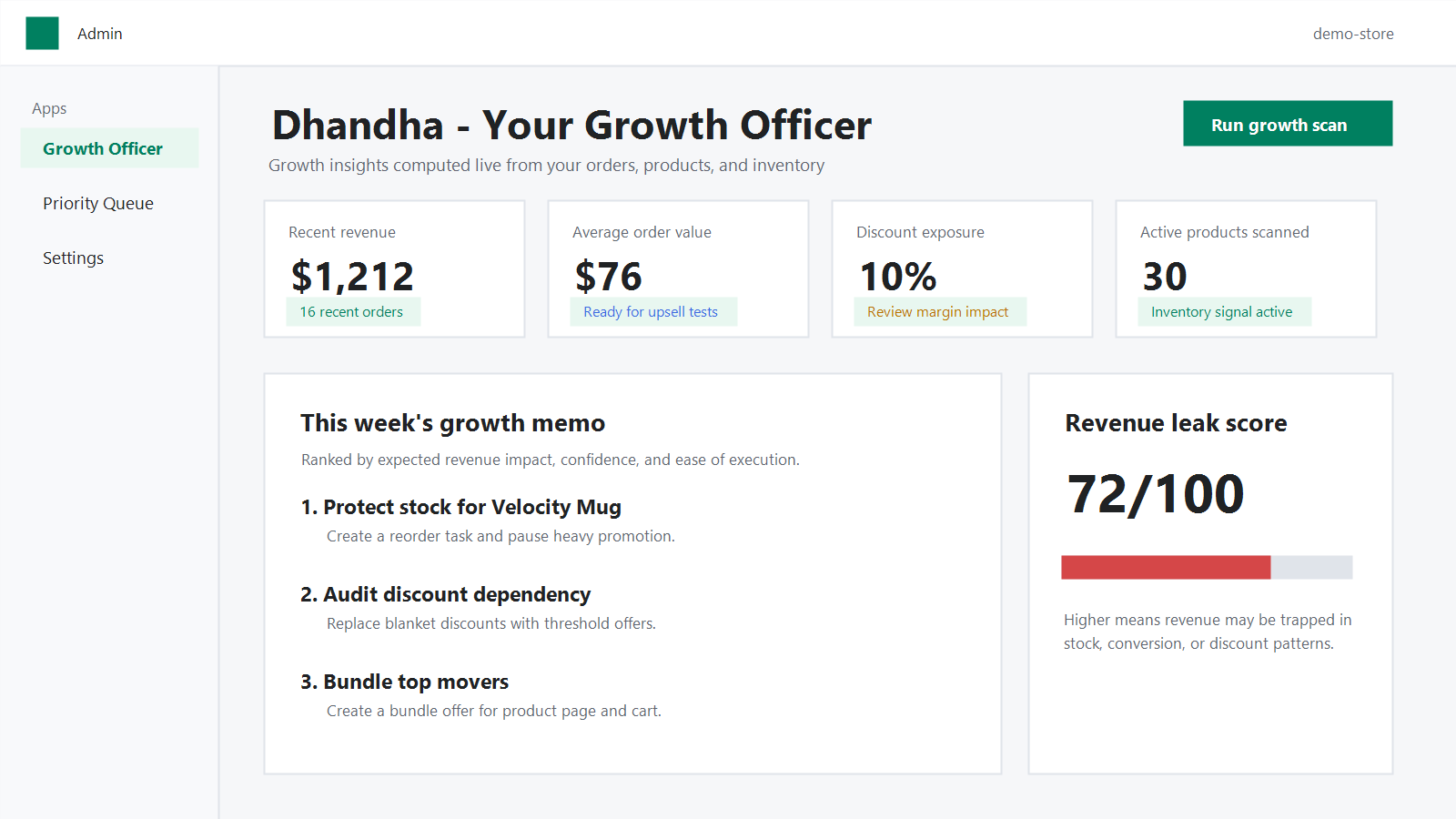
Dhandha is a live Shopify app that reviews relevant order, product, and inventory signals and ranks a short queue of growth actions. It can surface overstock and bundle candidates so a merchant can decide what deserves attention this week.
Dhandha does not guarantee demand, profit, inventory accuracy, or bundle performance. A merchant should verify inventory, costs, product relationships, planned campaigns, supplier constraints, and the test design before publishing a bundle or changing replenishment.
Sources and definitions
Related Shopify resources
Frequently asked questions
How do I find overstock and bundle opportunities in Shopify?
Flag mature variants with high days of inventory, weak sell-through relative to comparable products, excess cover beyond their selling window, and meaningful cash exposure. Then evaluate complementary products with shared customer intent, safe component stock, and positive contribution. Overstock makes a product worth reviewing; it does not automatically make it a bundle candidate.
What Shopify metrics help identify overstock?
Use available inventory, recent units sold, days of inventory remaining, sell-through, ABC grade, inventory value, margin or contribution, product age, and seasonality. Review them at variant and location level when the detail changes the decision.
Should I bundle two slow-selling Shopify products?
Not merely because both are slow. The products should solve a shared customer job or buying occasion, have a clear reason to be purchased together, retain acceptable contribution, and have compatible inventory. Otherwise the bundle may hide weak demand without creating value.
How does Shopify calculate bundle inventory?
For each component, divide available inventory by the number of units required in one bundle and round down. The lowest result across all components determines bundle availability. A component with untracked inventory or continue-selling behavior can be treated differently under Shopify's documented rules.
How much should I discount a Shopify bundle?
There is no universal discount. Start with the contribution floor after component COGS, packaging, handling, payment costs, shipping impact, and expected returns. Then test the smallest incentive that makes the combined offer clear, while monitoring cannibalization of standalone sales.
Can Dhandha automatically decide which products to bundle?
Dhandha can surface and rank bundle candidates from relevant store signals, but the merchant should verify customer fit, inventory, costs, contribution, seasonality, supplier constraints, and the planned test. A recommendation is a review queue, not a guarantee of demand or profit.