Direct answer
Is COD or prepaid more profitable for my store?
Neither payment method is always more profitable. Compare COD and prepaid cohorts using realized contribution per placed order after discounts, COGS, outbound shipping, packaging, payment or COD fees, refunds, chargebacks, and return-to-origin costs. Use the same products, channels, locations, and mature delivery window. The better method is the one that retains more contribution, not the one with more placed revenue.
Placed revenue is the wrong comparison
A prepaid order usually records payment near checkout. A cash-on-delivery order is a manual payment order and can remain pending until payment is collected. Shopify's documentation distinguishes sales from payments: a sales report can show the value of goods even when the store has not yet received the money.
That timing makes placed revenue especially misleading for COD. Some orders will be delivered and collected, some will be canceled before dispatch, and some will return to origin after shipping costs have already been incurred. Compare realized outcomes after the cohort has had time to mature.
Build comparable COD and prepaid cohorts
- Use the same order-placement window and allow enough time for delivery, RTO, refunds, and chargebacks to settle.
- Compare the same products or control for product mix, because margin and return behavior can differ by SKU.
- Match country, region, shipping service, acquisition channel, and promotion where they materially affect cost or intent.
- Separate first-time and returning customers if their payment preferences and delivery behavior differ.
- Use placed orders as the denominator so rejected, canceled, returned, and undelivered orders remain visible.
Calculate realized contribution for each payment method
For delivered orders, start with item revenue actually retained after discounts and refunds. Subtract COGS, outbound shipping, packaging, payment-processing or COD collection fees, and other order-level costs. For a returned or RTO order, include outbound and return shipping, handling, lost packaging, and only the inventory loss that is actually unrecoverable.
Then divide the cohort's total realized contribution by all placed orders in that cohort. This produces contribution per placed order. Also track contribution per delivered order, delivery rate, cancellation rate, RTO rate, refund rate, and time to collection so one average does not hide the reason for the difference.
Illustrative comparison, not a benchmark
COD cohort: 100 placed orders, 70 delivered at INR 350 contribution each, and 30 RTO orders costing INR 160 each. Total realized contribution is INR 19,700, or INR 197 per placed order.
Prepaid cohort: 100 placed orders, 94 retained after refunds at INR 330 contribution each, with six return or refund cases costing another INR 120 each. Total realized contribution is INR 30,300, or INR 303 per placed order.
The example only demonstrates the method. Replace every rate and cost with the store's actual settled data before changing payment options.
Use the right Shopify statuses and reports
Shopify marks orders using manual payment methods such as COD as pending until payment is received and recorded. Payment status, fulfillment status, delivery status, returns, refunds, and payment method answer different questions. Keep those states separate when building a cohort.
Shopify's sales reports represent sales and reversals, while payments finance reports represent captured payment activity. Profit reports can include product charges, shipping charges, customer duties, recorded product costs, shipping costs, and related fields, but the result depends on the cost data available. COD handling, RTO shipping, packaging loss, and external carrier charges may still require store-specific inputs.
Diagnose why the methods differ
If COD contribution is lower, separate delivery failure from weak unit economics. A good delivered-order margin can still produce poor contribution per placed order when RTO is high. Review the pattern by product, region, carrier, customer type, order value, and acquisition source before applying a storewide rule.
If prepaid contribution is lower, inspect discounts used to encourage prepayment, payment fees, refunds, chargebacks, and product mix. A payment-method label is not the cause by itself. The operational and customer differences behind the cohort determine what can be changed.
Choose a reversible action
- Adjust a COD fee or prepaid incentive only after modeling its effect on conversion and contribution.
- Restrict COD narrowly where a verified region, product, or risk segment creates repeated losses instead of making an unsupported storewide change.
- Improve address confirmation, fulfillment timing, or carrier choice when operations drive the gap.
- Retest using a new mature cohort and the same calculation before calling the change successful.
Where Munafa fits
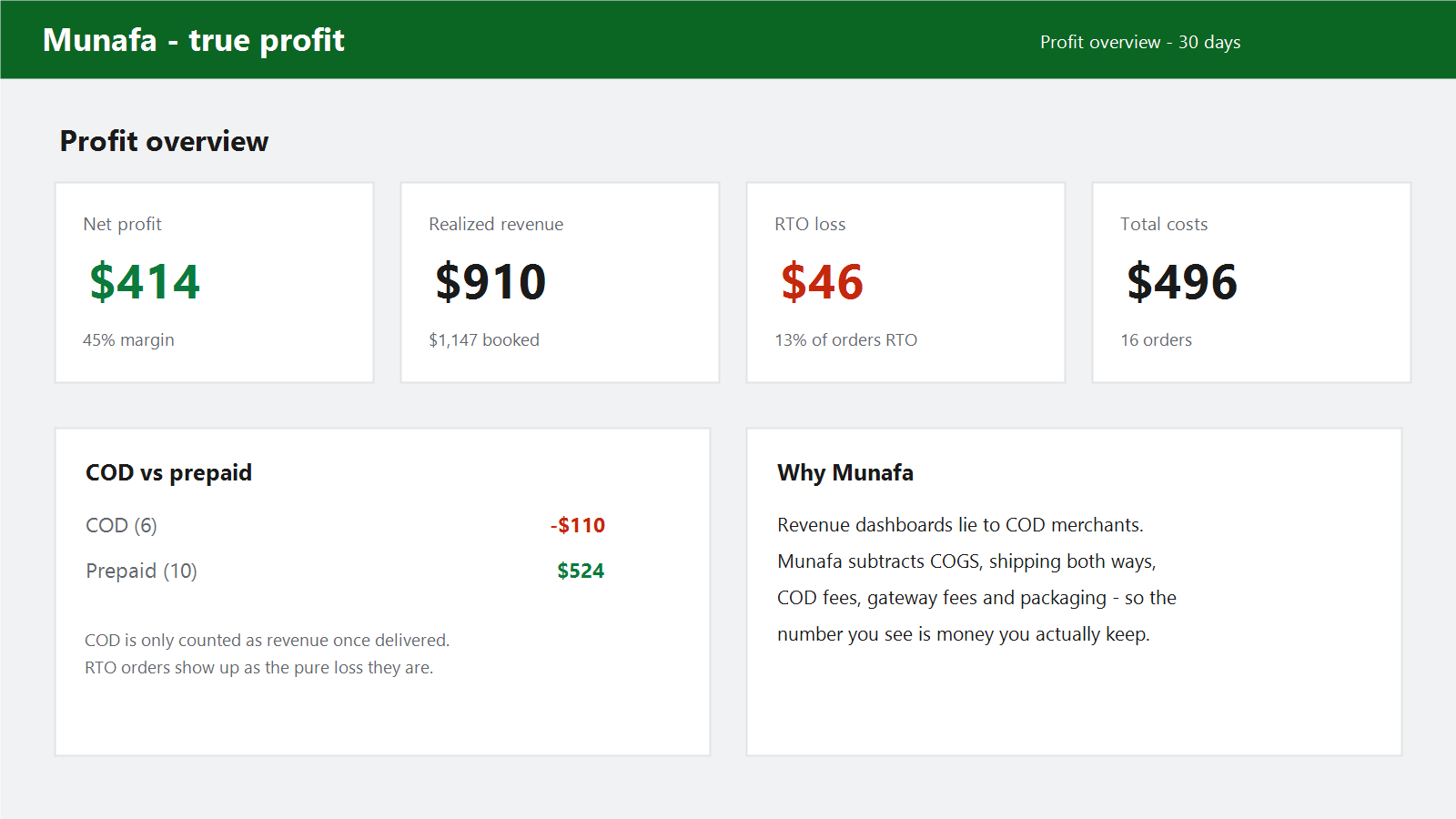
Munafa is a live Shopify app that calculates true order profit after COGS, shipping, packaging, payment fees, COD fees, and RTO losses. It helps merchants compare realized economics inside Shopify Admin instead of treating revenue as profit.
The calculation is only as reliable as the cost inputs, mappings, and maturity of the selected orders. Munafa does not guarantee profit, predict customer behavior, replace accounting records, or decide which payment method a merchant must offer.
Sources and definitions
Related Shopify resources
Frequently asked questions
Is COD or prepaid more profitable for my Shopify store?
It depends on the store's realized delivery, return, refund, cost, and contribution data. Compare contribution per placed order for matched, mature cohorts. COD can add RTO and collection costs; prepaid can add processing costs, refunds, chargebacks, or incentives. The more profitable method is the one that retains more contribution after all of them.
How do I calculate COD profit per placed order?
Add the contribution from delivered and collected COD orders, subtract the losses from canceled, undelivered, and RTO orders, then divide by all COD orders placed in the cohort. Include verified COGS, shipping in both directions, packaging, COD fees, handling, and unrecoverable inventory loss.
Should I count a pending COD order as revenue?
Do not treat it as collected cash or realized profit. Shopify can record the sale while a manual-payment order remains pending. Keep booked sales, payment collection, delivery, refunds, and contribution as separate measures until the order reaches a settled outcome.
Do manual COD payments have Shopify transaction fees?
Shopify states that third-party transaction fees do not apply to manual payment methods such as cash on delivery. A merchant can still incur carrier collection charges, payment-service costs, shipping, handling, or other store-specific COD expenses, so the absence of that Shopify fee does not make COD free.
How long should I wait before comparing COD and prepaid profit?
Wait until both cohorts have had enough time for delivery, return-to-origin, refunds, and chargebacks to mature. Use the same placement window and a fixed cutoff. Comparing settled prepaid orders with newly placed COD orders creates a timing bias.
Can Munafa tell me which payment method to disable?
Munafa can help calculate and compare realized profit using store data and cost assumptions. The merchant still needs to review data completeness, customer and regional differences, conversion effects, operational constraints, and the risk of any change before altering payment availability.